level <- function(w, b, x) sum(w * x) + b

w2 <- c(1, 1)
b2 <- -1
point_line <- -b2 / sum(w2 * w2) * w2
v <- c(-w2[2], w2[1])
line_levels <- sapply(-2:2, function(t) level(w2, b2, point_line + t * v))

w3 <- c(1, 1, 1)
b3 <- -1
point_plane <- -b3 / sum(w3 * w3) * w3
v1 <- c(1, -1, 0)
v2 <- c(0, 1, -1)
grid <- expand.grid(s = -2:2, t = -2:2)
plane_levels <- mapply(
  function(s, t) level(w3, b3, point_plane + s * v1 + t * v2),
  grid$s, grid$t
)

c(
  origin_in_R2 = level(w2, b2, c(0, 0)),
  origin_in_R3 = level(w3, b3, c(0, 0, 0)),
  origin_with_b0 = level(w3, 0, c(0, 0, 0))
)
#>   origin_in_R2   origin_in_R3 origin_with_b0
#> -1 -1 0Affine Subspaces and Half-Spaces
1 Affine subspaces and half-spaces
DefDefinition 1 (Affine subspace)
Definition 1 (Affine subspace) An affine subspace [1] of \(\mathbb{R}^p\) is a set of the form
\[ \mathopen{}\left\{\mathord{\smash[b]{\underset{\raise.3ex\hbox{$\scriptstyle\sim$}}{x}}\vphantom{x}}_0 + \mathord{\smash[b]{\underset{\raise.3ex\hbox{$\scriptstyle\sim$}}{s}}\vphantom{s}} : \mathord{\smash[b]{\underset{\raise.3ex\hbox{$\scriptstyle\sim$}}{s}}\vphantom{s}} \in \mathcal{S}\right\}\mathclose{} \]
for some vector \(\mathord{\smash[b]{\underset{\raise.3ex\hbox{$\scriptstyle\sim$}}{x}}\vphantom{x}}_0 \in \mathbb{R}^p\) and some subspace \(\mathcal{S}\) of \(\mathbb{R}^p\) (Definition 4 in Subspaces and Rank): the image of \(\mathcal{S}\) under the translation by \(\mathord{\smash[b]{\underset{\raise.3ex\hbox{$\scriptstyle\sim$}}{x}}\vphantom{x}}_0\) (Definition 6 in Linear and Affine Maps).
ExmExample 1 (A line that misses the origin is an affine subspace)
Example 1 (A line that misses the origin is an affine subspace) The line \(\mathcal{T} = \mathopen{}\left\{(x, 1) : x \in \mathbb{R}\right\}\mathclose{}\) of Example 4 in Subspaces and Rank is not a subspace, but it is an affine subspace, with \(\mathord{\smash[b]{\underset{\raise.3ex\hbox{$\scriptstyle\sim$}}{x}}\vphantom{x}}_0 = (0, 1)\) and \(\mathcal{S} = \operatorname{span}\mathopen{}\left\{(1, 0)\right\}\mathclose{}\) (Definition 5 in Subspaces and Rank):
\[ \begin{aligned} (0, 1) + c\,(1, 0) &= (0 + c,\; 1 + 0) && \text{(}\href{linear-algebra-matrices.qmd#def-scalar-mult}{\text{Definition~9 in Matrices}}\text{, }\href{linear-algebra-vectors.qmd#def-vector-addition}{\text{Definition~9 in Vectors}}\text{)} \\ &= (c, 1), && \text{(add)} \end{aligned} \]
and as \(c\) ranges over \(\mathbb{R}\), \((c, 1)\) ranges over all of \(\mathcal{T}\). Every subspace \(\mathcal{S}\) is also an affine subspace, with \(\mathord{\smash[b]{\underset{\raise.3ex\hbox{$\scriptstyle\sim$}}{x}}\vphantom{x}}_0 = \mathord{\smash[b]{\underset{\raise.3ex\hbox{$\scriptstyle\sim$}}{0}}\vphantom{0}}\).
ExrExercise 1 (Writing a line as an affine subspace)
Exercise 1 (Writing a line as an affine subspace) A line such as \(y = 2x + 3\) in \(\mathbb{R}^2\) misses the origin, so it is not a subspace, but it is an affine subspace. Let \(\mathcal{T} = \mathopen{}\left\{(x, 2x + 3) : x \in \mathbb{R}\right\}\mathclose{}\).
Find a vector \(\mathord{\smash[b]{\underset{\raise.3ex\hbox{$\scriptstyle\sim$}}{x}}\vphantom{x}}_0\) and a subspace \(\mathcal{S}\) with \(\mathcal{T} = \mathopen{}\left\{\mathord{\smash[b]{\underset{\raise.3ex\hbox{$\scriptstyle\sim$}}{x}}\vphantom{x}}_0 + \mathord{\smash[b]{\underset{\raise.3ex\hbox{$\scriptstyle\sim$}}{s}}\vphantom{s}} : \mathord{\smash[b]{\underset{\raise.3ex\hbox{$\scriptstyle\sim$}}{s}}\vphantom{s}} \in \mathcal{S}\right\}\mathclose{}\).
TipHint
Take \(\mathord{\smash[b]{\underset{\raise.3ex\hbox{$\scriptstyle\sim$}}{x}}\vphantom{x}}_0\) to be the point of \(\mathcal{T}\) with \(x = 0\), and see what is left of \((x, 2x + 3)\) once you subtract it.
Theorem 1 (A hyperplane is a translated subspace of dimension \(p - 1\)) Let \(\mathord{\smash[b]{\underset{\raise.3ex\hbox{$\scriptstyle\sim$}}{w}}\vphantom{w}} \in \mathbb{R}^p\) be nonzero, let \(b \in \mathbb{R}\), let \(\mathcal{H} = \mathopen{}\left\{\mathord{\smash[b]{\underset{\raise.3ex\hbox{$\scriptstyle\sim$}}{x}}\vphantom{x}}\in \mathbb{R}^p : \mathord{\smash[b]{\underset{\raise.3ex\hbox{$\scriptstyle\sim$}}{w}}\vphantom{w}}^{\top} \mathord{\smash[b]{\underset{\raise.3ex\hbox{$\scriptstyle\sim$}}{x}}\vphantom{x}}+ b = 0\right\}\mathclose{}\) be the hyperplane with normal vector \(\mathord{\smash[b]{\underset{\raise.3ex\hbox{$\scriptstyle\sim$}}{w}}\vphantom{w}}\) and offset \(b\) (Definition 10 in Linear and Affine Maps), and let \(\mathcal{H}_0 = \mathopen{}\left\{\mathord{\smash[b]{\underset{\raise.3ex\hbox{$\scriptstyle\sim$}}{x}}\vphantom{x}}\in \mathbb{R}^p : \mathord{\smash[b]{\underset{\raise.3ex\hbox{$\scriptstyle\sim$}}{w}}\vphantom{w}}^{\top} \mathord{\smash[b]{\underset{\raise.3ex\hbox{$\scriptstyle\sim$}}{x}}\vphantom{x}}= 0\right\}\mathclose{}\) be the hyperplane with the same normal vector and offset \(0\).
- \(\mathcal{H}_0\) is a subspace of \(\mathbb{R}^p\) (Definition 4 in Subspaces and Rank) of dimension \(p - 1\) (Definition 9 in Subspaces and Rank).
- \(\mathcal{H}\) is not empty, and for any \(\mathord{\smash[b]{\underset{\raise.3ex\hbox{$\scriptstyle\sim$}}{x}}\vphantom{x}}_0 \in \mathcal{H}\), \(\mathcal{H} = \mathopen{}\left\{\mathord{\smash[b]{\underset{\raise.3ex\hbox{$\scriptstyle\sim$}}{x}}\vphantom{x}}_0 + \mathord{\smash[b]{\underset{\raise.3ex\hbox{$\scriptstyle\sim$}}{s}}\vphantom{s}} : \mathord{\smash[b]{\underset{\raise.3ex\hbox{$\scriptstyle\sim$}}{s}}\vphantom{s}} \in \mathcal{H}_0\right\}\mathclose{}\), so \(\mathcal{H}\) is an affine subspace (Definition 1).
- For any \(\mathord{\smash[b]{\underset{\raise.3ex\hbox{$\scriptstyle\sim$}}{x}}\vphantom{x}}, \mathord{\smash[b]{\underset{\raise.3ex\hbox{$\scriptstyle\sim$}}{y}}\vphantom{y}}\in \mathcal{H}\), the normal vector is orthogonal to their difference: \(\mathord{\smash[b]{\underset{\raise.3ex\hbox{$\scriptstyle\sim$}}{w}}\vphantom{w}} \perp (\mathord{\smash[b]{\underset{\raise.3ex\hbox{$\scriptstyle\sim$}}{x}}\vphantom{x}}- \mathord{\smash[b]{\underset{\raise.3ex\hbox{$\scriptstyle\sim$}}{y}}\vphantom{y}})\) (Definition 22 in Vectors).
ProofProof
Proof. Here \(\mathord{\smash[b]{\underset{\raise.3ex\hbox{$\scriptstyle\sim$}}{w}}\vphantom{w}}^{\top}\) is a \(1 \times p\) matrix, and \(\mathord{\smash[b]{\underset{\raise.3ex\hbox{$\scriptstyle\sim$}}{w}}\vphantom{w}}^{\top} \mathord{\smash[b]{\underset{\raise.3ex\hbox{$\scriptstyle\sim$}}{x}}\vphantom{x}}= \mathord{\smash[b]{\underset{\raise.3ex\hbox{$\scriptstyle\sim$}}{w}}\vphantom{w}} \cdot \mathord{\smash[b]{\underset{\raise.3ex\hbox{$\scriptstyle\sim$}}{x}}\vphantom{x}}\) (Example 3 in Matrix Multiplication).
Part 1. \(\mathcal{H}_0\) is the null space \(\mathcal{N}(\mathord{\smash[b]{\underset{\raise.3ex\hbox{$\scriptstyle\sim$}}{w}}\vphantom{w}}^{\top})\) (Definition 3 in Column Space and Null Space), so it is a subspace (Theorem 2 in Column Space and Null Space). The \(p\) columns of \(\mathord{\smash[b]{\underset{\raise.3ex\hbox{$\scriptstyle\sim$}}{w}}\vphantom{w}}^{\top}\) are the numbers \(w_1, \ldots, w_p\). Some \(w_j \ne 0\), because \(\mathord{\smash[b]{\underset{\raise.3ex\hbox{$\scriptstyle\sim$}}{w}}\vphantom{w}} \ne \mathord{\smash[b]{\underset{\raise.3ex\hbox{$\scriptstyle\sim$}}{0}}\vphantom{0}}\), and that column on its own is linearly independent (\(c\,w_j = 0\) forces \(c = 0\)), so \(\operatorname{rank}(\mathord{\smash[b]{\underset{\raise.3ex\hbox{$\scriptstyle\sim$}}{w}}\vphantom{w}}^{\top}) \ge 1\) (Definition 2 in Subspaces and Rank); and \(\operatorname{rank}(\mathord{\smash[b]{\underset{\raise.3ex\hbox{$\scriptstyle\sim$}}{w}}\vphantom{w}}^{\top}) \le \min\mathopen{}\left\{1, p\right\}\mathclose{} = 1\) (Corollary 1 in Rank-Nullity and Rank Factorization). So
\[ \begin{aligned} \dim(\mathcal{H}_0) &= \operatorname{nullity}(\mathord{\smash[b]{\underset{\raise.3ex\hbox{$\scriptstyle\sim$}}{w}}\vphantom{w}}^{\top}) && \text{(}\href{linear-algebra-rank-nullity.qmd#def-nullity}{\text{Definition~1 in Rank-Nullity and Rank Factorization}}\text{)} \\ &= p - \operatorname{rank}(\mathord{\smash[b]{\underset{\raise.3ex\hbox{$\scriptstyle\sim$}}{w}}\vphantom{w}}^{\top}) && \text{(}\href{linear-algebra-rank-nullity.qmd#thm-rank-nullity}{\text{Theorem~2 in Rank-Nullity and Rank Factorization}}\text{, for the } p \text{ columns of } \mathord{\smash[b]{\underset{\raise.3ex\hbox{$\scriptstyle\sim$}}{w}}\vphantom{w}}^{\top} \text{)} \\ &= p - 1. && \text{(the rank is } 1 \text{)} \end{aligned} \]
Part 2. \(\mathord{\smash[b]{\underset{\raise.3ex\hbox{$\scriptstyle\sim$}}{w}}\vphantom{w}} \cdot \mathord{\smash[b]{\underset{\raise.3ex\hbox{$\scriptstyle\sim$}}{w}}\vphantom{w}} = w_1^2 + \cdots + w_p^2 > 0\), because some \(w_j \ne 0\). So \(\mathord{\smash[b]{\underset{\raise.3ex\hbox{$\scriptstyle\sim$}}{x}}\vphantom{x}}^* \stackrel{\text{def}}{=}-\frac{b}{\mathord{\smash[b]{\underset{\raise.3ex\hbox{$\scriptstyle\sim$}}{w}}\vphantom{w}} \cdot \mathord{\smash[b]{\underset{\raise.3ex\hbox{$\scriptstyle\sim$}}{w}}\vphantom{w}}}\,\mathord{\smash[b]{\underset{\raise.3ex\hbox{$\scriptstyle\sim$}}{w}}\vphantom{w}}\) is defined, and
\[ \begin{aligned} \mathord{\smash[b]{\underset{\raise.3ex\hbox{$\scriptstyle\sim$}}{w}}\vphantom{w}}^{\top} \mathord{\smash[b]{\underset{\raise.3ex\hbox{$\scriptstyle\sim$}}{x}}\vphantom{x}}^* + b &= -\frac{b}{\mathord{\smash[b]{\underset{\raise.3ex\hbox{$\scriptstyle\sim$}}{w}}\vphantom{w}} \cdot \mathord{\smash[b]{\underset{\raise.3ex\hbox{$\scriptstyle\sim$}}{w}}\vphantom{w}}}\,(\mathord{\smash[b]{\underset{\raise.3ex\hbox{$\scriptstyle\sim$}}{w}}\vphantom{w}}^{\top} \mathord{\smash[b]{\underset{\raise.3ex\hbox{$\scriptstyle\sim$}}{w}}\vphantom{w}}) + b && \text{(homogeneity of } \mathord{\smash[b]{\underset{\raise.3ex\hbox{$\scriptstyle\sim$}}{x}}\vphantom{x}}\mapsto \mathord{\smash[b]{\underset{\raise.3ex\hbox{$\scriptstyle\sim$}}{w}}\vphantom{w}}^{\top} \mathord{\smash[b]{\underset{\raise.3ex\hbox{$\scriptstyle\sim$}}{x}}\vphantom{x}}\text{, }\href{linear-algebra-linear-maps.qmd#thm-matrix-map-linear}{\text{Theorem~2 in Linear and Affine Maps}}\text{)} \\ &= -b + b && \text{(} \mathord{\smash[b]{\underset{\raise.3ex\hbox{$\scriptstyle\sim$}}{w}}\vphantom{w}}^{\top} \mathord{\smash[b]{\underset{\raise.3ex\hbox{$\scriptstyle\sim$}}{w}}\vphantom{w}} = \mathord{\smash[b]{\underset{\raise.3ex\hbox{$\scriptstyle\sim$}}{w}}\vphantom{w}} \cdot \mathord{\smash[b]{\underset{\raise.3ex\hbox{$\scriptstyle\sim$}}{w}}\vphantom{w}} \text{)} \\ &= 0, && \text{(arithmetic)} \end{aligned} \]
so \(\mathord{\smash[b]{\underset{\raise.3ex\hbox{$\scriptstyle\sim$}}{x}}\vphantom{x}}^* \in \mathcal{H}\), and \(\mathcal{H}\) is not empty. Now take any \(\mathord{\smash[b]{\underset{\raise.3ex\hbox{$\scriptstyle\sim$}}{x}}\vphantom{x}}_0 \in \mathcal{H}\), so \(\mathord{\smash[b]{\underset{\raise.3ex\hbox{$\scriptstyle\sim$}}{w}}\vphantom{w}}^{\top} \mathord{\smash[b]{\underset{\raise.3ex\hbox{$\scriptstyle\sim$}}{x}}\vphantom{x}}_0 = -b\). For any \(\mathord{\smash[b]{\underset{\raise.3ex\hbox{$\scriptstyle\sim$}}{x}}\vphantom{x}}\in \mathbb{R}^p\),
\[ \begin{aligned} \mathord{\smash[b]{\underset{\raise.3ex\hbox{$\scriptstyle\sim$}}{w}}\vphantom{w}}^{\top} (\mathord{\smash[b]{\underset{\raise.3ex\hbox{$\scriptstyle\sim$}}{x}}\vphantom{x}}- \mathord{\smash[b]{\underset{\raise.3ex\hbox{$\scriptstyle\sim$}}{x}}\vphantom{x}}_0) &= \mathord{\smash[b]{\underset{\raise.3ex\hbox{$\scriptstyle\sim$}}{w}}\vphantom{w}}^{\top} \mathord{\smash[b]{\underset{\raise.3ex\hbox{$\scriptstyle\sim$}}{x}}\vphantom{x}}- \mathord{\smash[b]{\underset{\raise.3ex\hbox{$\scriptstyle\sim$}}{w}}\vphantom{w}}^{\top} \mathord{\smash[b]{\underset{\raise.3ex\hbox{$\scriptstyle\sim$}}{x}}\vphantom{x}}_0 && \text{(}\href{linear-algebra-subspaces.qmd#thm-matvec-linear}{\text{Theorem~4 in Subspaces and Rank}}\text{, with coefficients } 1 \text{ and } -1 \text{)} \\ &= \mathord{\smash[b]{\underset{\raise.3ex\hbox{$\scriptstyle\sim$}}{w}}\vphantom{w}}^{\top} \mathord{\smash[b]{\underset{\raise.3ex\hbox{$\scriptstyle\sim$}}{x}}\vphantom{x}}- (-b) && \text{(} \mathord{\smash[b]{\underset{\raise.3ex\hbox{$\scriptstyle\sim$}}{x}}\vphantom{x}}_0 \in \mathcal{H} \text{)} \\ &= \mathord{\smash[b]{\underset{\raise.3ex\hbox{$\scriptstyle\sim$}}{w}}\vphantom{w}}^{\top} \mathord{\smash[b]{\underset{\raise.3ex\hbox{$\scriptstyle\sim$}}{x}}\vphantom{x}}+ b, && \text{(arithmetic)} \end{aligned} \]
so \(\mathord{\smash[b]{\underset{\raise.3ex\hbox{$\scriptstyle\sim$}}{x}}\vphantom{x}}\in \mathcal{H}\) exactly when \(\mathord{\smash[b]{\underset{\raise.3ex\hbox{$\scriptstyle\sim$}}{x}}\vphantom{x}}- \mathord{\smash[b]{\underset{\raise.3ex\hbox{$\scriptstyle\sim$}}{x}}\vphantom{x}}_0 \in \mathcal{H}_0\), that is, exactly when \(\mathord{\smash[b]{\underset{\raise.3ex\hbox{$\scriptstyle\sim$}}{x}}\vphantom{x}}= \mathord{\smash[b]{\underset{\raise.3ex\hbox{$\scriptstyle\sim$}}{x}}\vphantom{x}}_0 + \mathord{\smash[b]{\underset{\raise.3ex\hbox{$\scriptstyle\sim$}}{s}}\vphantom{s}}\) with \(\mathord{\smash[b]{\underset{\raise.3ex\hbox{$\scriptstyle\sim$}}{s}}\vphantom{s}} = \mathord{\smash[b]{\underset{\raise.3ex\hbox{$\scriptstyle\sim$}}{x}}\vphantom{x}}- \mathord{\smash[b]{\underset{\raise.3ex\hbox{$\scriptstyle\sim$}}{x}}\vphantom{x}}_0 \in \mathcal{H}_0\). \(\mathcal{H}_0\) is a subspace (part 1), so \(\mathcal{H}\) has the form in Definition 1.
Part 3. For \(\mathord{\smash[b]{\underset{\raise.3ex\hbox{$\scriptstyle\sim$}}{x}}\vphantom{x}}, \mathord{\smash[b]{\underset{\raise.3ex\hbox{$\scriptstyle\sim$}}{y}}\vphantom{y}}\in \mathcal{H}\), both \(\mathord{\smash[b]{\underset{\raise.3ex\hbox{$\scriptstyle\sim$}}{w}}\vphantom{w}}^{\top} \mathord{\smash[b]{\underset{\raise.3ex\hbox{$\scriptstyle\sim$}}{x}}\vphantom{x}}\) and \(\mathord{\smash[b]{\underset{\raise.3ex\hbox{$\scriptstyle\sim$}}{w}}\vphantom{w}}^{\top} \mathord{\smash[b]{\underset{\raise.3ex\hbox{$\scriptstyle\sim$}}{y}}\vphantom{y}}\) equal \(-b\), so
\[ \begin{aligned} \mathord{\smash[b]{\underset{\raise.3ex\hbox{$\scriptstyle\sim$}}{w}}\vphantom{w}} \cdot (\mathord{\smash[b]{\underset{\raise.3ex\hbox{$\scriptstyle\sim$}}{x}}\vphantom{x}}- \mathord{\smash[b]{\underset{\raise.3ex\hbox{$\scriptstyle\sim$}}{y}}\vphantom{y}}) &= \mathord{\smash[b]{\underset{\raise.3ex\hbox{$\scriptstyle\sim$}}{w}}\vphantom{w}}^{\top} \mathord{\smash[b]{\underset{\raise.3ex\hbox{$\scriptstyle\sim$}}{x}}\vphantom{x}}- \mathord{\smash[b]{\underset{\raise.3ex\hbox{$\scriptstyle\sim$}}{w}}\vphantom{w}}^{\top} \mathord{\smash[b]{\underset{\raise.3ex\hbox{$\scriptstyle\sim$}}{y}}\vphantom{y}} && \text{(}\href{linear-algebra-subspaces.qmd#thm-matvec-linear}{\text{Theorem~4 in Subspaces and Rank}}\text{, with coefficients } 1 \text{ and } -1 \text{)} \\ &= (-b) - (-b) && \text{(} \mathord{\smash[b]{\underset{\raise.3ex\hbox{$\scriptstyle\sim$}}{x}}\vphantom{x}}, \mathord{\smash[b]{\underset{\raise.3ex\hbox{$\scriptstyle\sim$}}{y}}\vphantom{y}}\in \mathcal{H} \text{)} \\ &= 0. && \text{(arithmetic)} \end{aligned} \]
Example 2 (The plane \(x_1 + x_2 + x_3 = 1\) in \(\mathbb{R}^3\)) Take \(\mathord{\smash[b]{\underset{\raise.3ex\hbox{$\scriptstyle\sim$}}{w}}\vphantom{w}} = (1, 1, 1)\) and \(b = -1\), so \(\mathcal{H} = \mathopen{}\left\{\mathord{\smash[b]{\underset{\raise.3ex\hbox{$\scriptstyle\sim$}}{x}}\vphantom{x}}: x_1 + x_2 + x_3 - 1 = 0\right\}\mathclose{}\), the plane that Example 5 in Subspaces and Rank showed is not a subspace. By part 1, \(\mathcal{H}_0 = \mathopen{}\left\{\mathord{\smash[b]{\underset{\raise.3ex\hbox{$\scriptstyle\sim$}}{x}}\vphantom{x}}: x_1 + x_2 + x_3 = 0\right\}\mathclose{}\) is a subspace of dimension \(3 - 1 = 2\).
\(\mathord{\smash[b]{\underset{\raise.3ex\hbox{$\scriptstyle\sim$}}{x}}\vphantom{x}}_0 = (1, 0, 0)\) is in \(\mathcal{H}\), since \(1 + 0 + 0 - 1 = 0\), and so is \(\mathord{\smash[b]{\underset{\raise.3ex\hbox{$\scriptstyle\sim$}}{y}}\vphantom{y}}= (0, 1, 0)\).
Their difference \(\mathord{\smash[b]{\underset{\raise.3ex\hbox{$\scriptstyle\sim$}}{y}}\vphantom{y}}- \mathord{\smash[b]{\underset{\raise.3ex\hbox{$\scriptstyle\sim$}}{x}}\vphantom{x}}_0 = (-1, 1, 0)\) has entries summing to \(-1 + 1 + 0 = 0\), so it is in \(\mathcal{H}_0\), and \(\mathord{\smash[b]{\underset{\raise.3ex\hbox{$\scriptstyle\sim$}}{y}}\vphantom{y}}= \mathord{\smash[b]{\underset{\raise.3ex\hbox{$\scriptstyle\sim$}}{x}}\vphantom{x}}_0 + (-1, 1, 0)\), as part 2 says.
-
\[ \begin{aligned} \mathord{\smash[b]{\underset{\raise.3ex\hbox{$\scriptstyle\sim$}}{w}}\vphantom{w}} \cdot (-1, 1, 0) &= -1 + 1 + 0 \\ &= 0, \end{aligned} \]
as part 3 says.
-
The point built in the proof is
\[ \begin{aligned} \mathord{\smash[b]{\underset{\raise.3ex\hbox{$\scriptstyle\sim$}}{x}}\vphantom{x}}^* &= -\frac{-1}{3}\,(1, 1, 1) \\ &= \mathopen{}\left(\tfrac{1}{3}, \tfrac{1}{3}, \tfrac{1}{3}\right)\mathclose{}, \end{aligned} \]
and \(\tfrac{1}{3} + \tfrac{1}{3} + \tfrac{1}{3} - 1 = 0\).
ExrExercise 2 (Checking that a normal vector is orthogonal to a hyperplane)
Exercise 2 (Checking that a normal vector is orthogonal to a hyperplane) Part 3 of Theorem 1 says that, for a hyperplane, its normal vector is orthogonal to the difference of any two of its points. Let \(\mathcal{H} = \mathopen{}\left\{\mathord{\smash[b]{\underset{\raise.3ex\hbox{$\scriptstyle\sim$}}{x}}\vphantom{x}}\in \mathbb{R}^3 : 2 x_1 - x_2 + x_3 - 4 = 0\right\}\mathclose{}\), with normal vector \(\mathord{\smash[b]{\underset{\raise.3ex\hbox{$\scriptstyle\sim$}}{w}}\vphantom{w}} = (2, -1, 1)\). The points \(\mathord{\smash[b]{\underset{\raise.3ex\hbox{$\scriptstyle\sim$}}{x}}\vphantom{x}}= (2, 0, 0)\) and \(\mathord{\smash[b]{\underset{\raise.3ex\hbox{$\scriptstyle\sim$}}{y}}\vphantom{y}}= (0, 0, 4)\) are both in \(\mathcal{H}\).
Check that \(\mathord{\smash[b]{\underset{\raise.3ex\hbox{$\scriptstyle\sim$}}{w}}\vphantom{w}} \cdot (\mathord{\smash[b]{\underset{\raise.3ex\hbox{$\scriptstyle\sim$}}{x}}\vphantom{x}}- \mathord{\smash[b]{\underset{\raise.3ex\hbox{$\scriptstyle\sim$}}{y}}\vphantom{y}}) = 0\).
TipHint
Compute \(\mathord{\smash[b]{\underset{\raise.3ex\hbox{$\scriptstyle\sim$}}{x}}\vphantom{x}}- \mathord{\smash[b]{\underset{\raise.3ex\hbox{$\scriptstyle\sim$}}{y}}\vphantom{y}}\) first.
Theorem 2 (Where a hyperplane passes, and its shape in \(\mathbb{R}^2\) and \(\mathbb{R}^3\)) Let \(\mathcal{H} = \mathopen{}\left\{\mathord{\smash[b]{\underset{\raise.3ex\hbox{$\scriptstyle\sim$}}{x}}\vphantom{x}}\in \mathbb{R}^p : \mathord{\smash[b]{\underset{\raise.3ex\hbox{$\scriptstyle\sim$}}{w}}\vphantom{w}} \cdot \mathord{\smash[b]{\underset{\raise.3ex\hbox{$\scriptstyle\sim$}}{x}}\vphantom{x}} + b = 0\right\}\mathclose{}\) be a hyperplane (Definition 10 in Linear and Affine Maps).
- \(\mathcal{H}\) contains the origin \(\mathord{\smash[b]{\underset{\raise.3ex\hbox{$\scriptstyle\sim$}}{0}}\vphantom{0}}\) exactly when \(b = 0\).
- If \(p = 2\), then \(\mathcal{H}\) is a line: \(\mathcal{H} = \mathopen{}\left\{\mathord{\smash[b]{\underset{\raise.3ex\hbox{$\scriptstyle\sim$}}{x}}\vphantom{x}}_0 + t\,\mathord{\smash[b]{\underset{\raise.3ex\hbox{$\scriptstyle\sim$}}{v}}\vphantom{v}} : t \in \mathbb{R}\right\}\mathclose{}\) for some \(\mathord{\smash[b]{\underset{\raise.3ex\hbox{$\scriptstyle\sim$}}{x}}\vphantom{x}}_0 \in \mathbb{R}^2\) and some nonzero \(\mathord{\smash[b]{\underset{\raise.3ex\hbox{$\scriptstyle\sim$}}{v}}\vphantom{v}} \in \mathbb{R}^2\).
- If \(p = 3\), then \(\mathcal{H}\) is a plane: \(\mathcal{H} = \mathopen{}\left\{\mathord{\smash[b]{\underset{\raise.3ex\hbox{$\scriptstyle\sim$}}{x}}\vphantom{x}}_0 + s\,\mathord{\smash[b]{\underset{\raise.3ex\hbox{$\scriptstyle\sim$}}{v}}\vphantom{v}}_1 + t\,\mathord{\smash[b]{\underset{\raise.3ex\hbox{$\scriptstyle\sim$}}{v}}\vphantom{v}}_2 : s, t \in \mathbb{R}\right\}\mathclose{}\) for some \(\mathord{\smash[b]{\underset{\raise.3ex\hbox{$\scriptstyle\sim$}}{x}}\vphantom{x}}_0 \in \mathbb{R}^3\) and some linearly independent \(\mathord{\smash[b]{\underset{\raise.3ex\hbox{$\scriptstyle\sim$}}{v}}\vphantom{v}}_1, \mathord{\smash[b]{\underset{\raise.3ex\hbox{$\scriptstyle\sim$}}{v}}\vphantom{v}}_2 \in \mathbb{R}^3\).
ProofProof
Proof. Part 1. Since \(\mathord{\smash[b]{\underset{\raise.3ex\hbox{$\scriptstyle\sim$}}{w}}\vphantom{w}} \cdot \mathord{\smash[b]{\underset{\raise.3ex\hbox{$\scriptstyle\sim$}}{0}}\vphantom{0}} = 0\),
\[ \begin{aligned} \mathord{\smash[b]{\underset{\raise.3ex\hbox{$\scriptstyle\sim$}}{w}}\vphantom{w}} \cdot \mathord{\smash[b]{\underset{\raise.3ex\hbox{$\scriptstyle\sim$}}{0}}\vphantom{0}} + b &= 0 + b && \text{(the dot product with } \mathord{\smash[b]{\underset{\raise.3ex\hbox{$\scriptstyle\sim$}}{0}}\vphantom{0}}\text{ is } 0 \text{)} \\ &= b, && \text{(}\href{algebra-sums.qmd#thm-add-ident}{\text{Theorem~4 in Convexity, Infimum and Sums}}\text{)} \end{aligned} \]
so \(\mathord{\smash[b]{\underset{\raise.3ex\hbox{$\scriptstyle\sim$}}{0}}\vphantom{0}}\in \mathcal{H}\) exactly when \(b = 0\).
Parts 2 and 3. By Theorem 1, \(\mathcal{H} = \mathopen{}\left\{\mathord{\smash[b]{\underset{\raise.3ex\hbox{$\scriptstyle\sim$}}{x}}\vphantom{x}}_0 + \mathord{\smash[b]{\underset{\raise.3ex\hbox{$\scriptstyle\sim$}}{s}}\vphantom{s}} : \mathord{\smash[b]{\underset{\raise.3ex\hbox{$\scriptstyle\sim$}}{s}}\vphantom{s}} \in \mathcal{H}_0\right\}\mathclose{}\) for any \(\mathord{\smash[b]{\underset{\raise.3ex\hbox{$\scriptstyle\sim$}}{x}}\vphantom{x}}_0 \in \mathcal{H}\), where \(\mathcal{H}_0\) is a subspace of \(\mathbb{R}^p\) of dimension \(p - 1\).
For \(p = 2\), \(\mathcal{H}_0\) has dimension \(1\), so it has a basis (Definition 6 in Subspaces and Rank) with one vector \(\mathord{\smash[b]{\underset{\raise.3ex\hbox{$\scriptstyle\sim$}}{v}}\vphantom{v}}\). That vector is nonzero, and \(\mathcal{H}_0 = \mathopen{}\left\{t\,\mathord{\smash[b]{\underset{\raise.3ex\hbox{$\scriptstyle\sim$}}{v}}\vphantom{v}} : t \in \mathbb{R}\right\}\mathclose{}\).
For \(p = 3\), \(\mathcal{H}_0\) has dimension \(2\), so it has a basis with two vectors \(\mathord{\smash[b]{\underset{\raise.3ex\hbox{$\scriptstyle\sim$}}{v}}\vphantom{v}}_1\) and \(\mathord{\smash[b]{\underset{\raise.3ex\hbox{$\scriptstyle\sim$}}{v}}\vphantom{v}}_2\). They are linearly independent, and \(\mathcal{H}_0 = \mathopen{}\left\{s\,\mathord{\smash[b]{\underset{\raise.3ex\hbox{$\scriptstyle\sim$}}{v}}\vphantom{v}}_1 + t\,\mathord{\smash[b]{\underset{\raise.3ex\hbox{$\scriptstyle\sim$}}{v}}\vphantom{v}}_2 : s, t \in \mathbb{R}\right\}\mathclose{}\).
ExmExample 3 (A line in \(\mathbb{R}^2\) and a plane in \(\mathbb{R}^3\), checked on a grid of points)
Example 3 (A line in \(\mathbb{R}^2\) and a plane in \(\mathbb{R}^3\), checked on a grid of points) In \(\mathbb{R}^2\), take \(\mathord{\smash[b]{\underset{\raise.3ex\hbox{$\scriptstyle\sim$}}{w}}\vphantom{w}} = (1, 1)\) and \(b = -1\), the line of Example 11 in Linear and Affine Maps. The point \(\mathord{\smash[b]{\underset{\raise.3ex\hbox{$\scriptstyle\sim$}}{x}}\vphantom{x}}_0 = -\frac{b}{\mathord{\smash[b]{\underset{\raise.3ex\hbox{$\scriptstyle\sim$}}{w}}\vphantom{w}} \cdot \mathord{\smash[b]{\underset{\raise.3ex\hbox{$\scriptstyle\sim$}}{w}}\vphantom{w}}}\,\mathord{\smash[b]{\underset{\raise.3ex\hbox{$\scriptstyle\sim$}}{w}}\vphantom{w}}\) is on it, and the vector \(\mathord{\smash[b]{\underset{\raise.3ex\hbox{$\scriptstyle\sim$}}{v}}\vphantom{v}} = (-w_2, w_1)\) is nonzero with \(\mathord{\smash[b]{\underset{\raise.3ex\hbox{$\scriptstyle\sim$}}{w}}\vphantom{w}} \cdot \mathord{\smash[b]{\underset{\raise.3ex\hbox{$\scriptstyle\sim$}}{v}}\vphantom{v}} = 0\), so it spans the subspace \(\mathcal{H}_0\) of Theorem 1. In \(\mathbb{R}^3\), take \(\mathord{\smash[b]{\underset{\raise.3ex\hbox{$\scriptstyle\sim$}}{w}}\vphantom{w}} = (1, 1, 1)\) and \(b = -1\), the plane of Example 2, with the independent vectors \(\mathord{\smash[b]{\underset{\raise.3ex\hbox{$\scriptstyle\sim$}}{v}}\vphantom{v}}_1 = (1, -1, 0)\) and \(\mathord{\smash[b]{\underset{\raise.3ex\hbox{$\scriptstyle\sim$}}{v}}\vphantom{v}}_2 = (0, 1, -1)\) in \(\mathcal{H}_0\). The code evaluates \(\mathord{\smash[b]{\underset{\raise.3ex\hbox{$\scriptstyle\sim$}}{w}}\vphantom{w}} \cdot \mathord{\smash[b]{\underset{\raise.3ex\hbox{$\scriptstyle\sim$}}{x}}\vphantom{x}} + b\) at the origin and at points \(\mathord{\smash[b]{\underset{\raise.3ex\hbox{$\scriptstyle\sim$}}{x}}\vphantom{x}}_0 + t\,\mathord{\smash[b]{\underset{\raise.3ex\hbox{$\scriptstyle\sim$}}{v}}\vphantom{v}}\) and \(\mathord{\smash[b]{\underset{\raise.3ex\hbox{$\scriptstyle\sim$}}{x}}\vphantom{x}}_0 + s\,\mathord{\smash[b]{\underset{\raise.3ex\hbox{$\scriptstyle\sim$}}{v}}\vphantom{v}}_1 + t\,\mathord{\smash[b]{\underset{\raise.3ex\hbox{$\scriptstyle\sim$}}{v}}\vphantom{v}}_2\).
At the origin the left side equals the offset, so the origin is on the line only if \(b\) is \(0\): it gives -1 for the line and -1 for the plane, and 0 once the offset is changed to \(0\). All 5 points \(\mathord{\smash[b]{\underset{\raise.3ex\hbox{$\scriptstyle\sim$}}{x}}\vphantom{x}}_0 + t\,\mathord{\smash[b]{\underset{\raise.3ex\hbox{$\scriptstyle\sim$}}{v}}\vphantom{v}}\) on the line and all 25 points \(\mathord{\smash[b]{\underset{\raise.3ex\hbox{$\scriptstyle\sim$}}{x}}\vphantom{x}}_0 + s\,\mathord{\smash[b]{\underset{\raise.3ex\hbox{$\scriptstyle\sim$}}{v}}\vphantom{v}}_1 + t\,\mathord{\smash[b]{\underset{\raise.3ex\hbox{$\scriptstyle\sim$}}{v}}\vphantom{v}}_2\) on the plane satisfy the equation up to rounding error: 30 of the 30 points have \(\mathopen{}\left|\mathord{\smash[b]{\underset{\raise.3ex\hbox{$\scriptstyle\sim$}}{w}}\vphantom{w}} \cdot \mathord{\smash[b]{\underset{\raise.3ex\hbox{$\scriptstyle\sim$}}{x}}\vphantom{x}} + b\right|\mathclose{} < 10^{-10}\).
Exercise 3 (Describing a line in \(\mathbb{R}^2\) by a point and a vector) Part 2 of Theorem 2 says that a hyperplane in \(\mathbb{R}^2\) is a line \(\mathopen{}\left\{\mathord{\smash[b]{\underset{\raise.3ex\hbox{$\scriptstyle\sim$}}{x}}\vphantom{x}}_0 + t\,\mathord{\smash[b]{\underset{\raise.3ex\hbox{$\scriptstyle\sim$}}{v}}\vphantom{v}} : t \in \mathbb{R}\right\}\mathclose{}\) for a point \(\mathord{\smash[b]{\underset{\raise.3ex\hbox{$\scriptstyle\sim$}}{x}}\vphantom{x}}_0\) and a nonzero vector \(\mathord{\smash[b]{\underset{\raise.3ex\hbox{$\scriptstyle\sim$}}{v}}\vphantom{v}}\). Let \(\mathcal{H} = \mathopen{}\left\{\mathord{\smash[b]{\underset{\raise.3ex\hbox{$\scriptstyle\sim$}}{x}}\vphantom{x}}\in \mathbb{R}^2 : 2 x_1 + x_2 - 4 = 0\right\}\mathclose{}\).
Find a point \(\mathord{\smash[b]{\underset{\raise.3ex\hbox{$\scriptstyle\sim$}}{x}}\vphantom{x}}_0\) and a nonzero vector \(\mathord{\smash[b]{\underset{\raise.3ex\hbox{$\scriptstyle\sim$}}{v}}\vphantom{v}}\) with \(\mathcal{H} = \mathopen{}\left\{\mathord{\smash[b]{\underset{\raise.3ex\hbox{$\scriptstyle\sim$}}{x}}\vphantom{x}}_0 + t\,\mathord{\smash[b]{\underset{\raise.3ex\hbox{$\scriptstyle\sim$}}{v}}\vphantom{v}} : t \in \mathbb{R}\right\}\mathclose{}\).
TipHint
Find one point of \(\mathcal{H}\) by setting \(x_2 = 0\), and take \(\mathord{\smash[b]{\underset{\raise.3ex\hbox{$\scriptstyle\sim$}}{v}}\vphantom{v}} = (-w_2, w_1)\) as in Example 3.
LemTheorem 3 (The graph of an affine function is a hyperplane)
Theorem 3 (The graph of an affine function is a hyperplane) Let \(\mathord{\smash[b]{\underset{\raise.3ex\hbox{$\scriptstyle\sim$}}{w}}\vphantom{w}}\in \mathbb{R}^p\), \(b \in \mathbb{R}\). The graph of the function \(\mathord{\smash[b]{\underset{\raise.3ex\hbox{$\scriptstyle\sim$}}{x}}\vphantom{x}}\mapsto \mathord{\smash[b]{\underset{\raise.3ex\hbox{$\scriptstyle\sim$}}{w}}\vphantom{w}} \cdot \mathord{\smash[b]{\underset{\raise.3ex\hbox{$\scriptstyle\sim$}}{x}}\vphantom{x}} + b\) is the set
\[ \mathopen{}\left\{\begin{bmatrix}\mathord{\smash[b]{\underset{\raise.3ex\hbox{$\scriptstyle\sim$}}{x}}\vphantom{x}}\\ y\end{bmatrix} \in \mathbb{R}^{p+1} : y = \mathord{\smash[b]{\underset{\raise.3ex\hbox{$\scriptstyle\sim$}}{w}}\vphantom{w}} \cdot \mathord{\smash[b]{\underset{\raise.3ex\hbox{$\scriptstyle\sim$}}{x}}\vphantom{x}} + b\right\}\mathclose{}. \]
This set is a hyperplane in \(\mathbb{R}^{p+1}\), with normal vector \(\begin{bmatrix}\mathord{\smash[b]{\underset{\raise.3ex\hbox{$\scriptstyle\sim$}}{w}}\vphantom{w}}\\ -1\end{bmatrix}\).
ProofProof
Proof. For \(\begin{bmatrix}\mathord{\smash[b]{\underset{\raise.3ex\hbox{$\scriptstyle\sim$}}{x}}\vphantom{x}}\\ y\end{bmatrix} \in \mathbb{R}^{p+1}\),
\[ \begin{aligned} y = \mathord{\smash[b]{\underset{\raise.3ex\hbox{$\scriptstyle\sim$}}{w}}\vphantom{w}} \cdot \mathord{\smash[b]{\underset{\raise.3ex\hbox{$\scriptstyle\sim$}}{x}}\vphantom{x}} + b &\iff \mathord{\smash[b]{\underset{\raise.3ex\hbox{$\scriptstyle\sim$}}{w}}\vphantom{w}} \cdot \mathord{\smash[b]{\underset{\raise.3ex\hbox{$\scriptstyle\sim$}}{x}}\vphantom{x}} - y + b = 0 && \text{(subtract } y \text{ from both sides)} \\ &\iff \begin{bmatrix}\mathord{\smash[b]{\underset{\raise.3ex\hbox{$\scriptstyle\sim$}}{w}}\vphantom{w}}\\ -1\end{bmatrix} \cdot \begin{bmatrix}\mathord{\smash[b]{\underset{\raise.3ex\hbox{$\scriptstyle\sim$}}{x}}\vphantom{x}}\\ y\end{bmatrix} + b = 0. && \text{(dot product of stacked vectors)} \end{aligned} \]
So the set is the solution set of the equation of a hyperplane, with normal vector \(\begin{bmatrix}\mathord{\smash[b]{\underset{\raise.3ex\hbox{$\scriptstyle\sim$}}{w}}\vphantom{w}}\\ -1\end{bmatrix}\). That vector is nonzero, because its last entry is \(-1\).
ExmExample 4 (The graph of a line is a line in the plane)
Example 4 (The graph of a line is a line in the plane) Take \(p = 1\), \(\mathord{\smash[b]{\underset{\raise.3ex\hbox{$\scriptstyle\sim$}}{w}}\vphantom{w}}= 2\), \(b = 1\). The graph of \(y = 2x + 1\) is the set of points \((x, y)\) in \(\mathbb{R}^2\) with \(2x - y + 1 = 0\). By Theorem 3, this is a hyperplane with normal vector \((2, -1)\). The point \((0, 1)\) is on it, since \(2 \cdot 0 - 1 + 1 = 0\). The point \((0, 0)\) is off it, since \(2 \cdot 0 - 0 + 1 = 1 \ne 0\). Figure 1 shows the line, the two points, and the normal vector drawn from \((0, 1)\).
Show code
arrow_length <- grid::unit(0.15, "inches")
normal_arrow <- grid::arrow(length = arrow_length)
point_x <- c(0, 0)
point_y <- c(1, 0)
point_label <- c("on the line", "off the line")
points <- tibble::tibble(x = point_x, y = point_y, label = point_label)
normal <- tibble::tibble(x = 0, y = 1, xend = 2, yend = 0)
normal_aes <- ggplot2::aes(x = x, y = y, xend = xend, yend = yend)
x_limits <- c(-2, 3)
y_limits <- c(-2, 4)
ggplot2::ggplot(points) +
  ggplot2::aes(x = x, y = y, colour = label) +
  ggplot2::geom_abline(intercept = 1, slope = 2) +
  ggplot2::geom_segment(
    mapping = normal_aes,
    data = normal,
    arrow = normal_arrow,
    inherit.aes = FALSE
  ) +
  ggplot2::geom_point(size = 3) +
  ggplot2::coord_fixed(xlim = x_limits, ylim = y_limits) +
  ggplot2::labs(x = "x", y = "y", colour = NULL)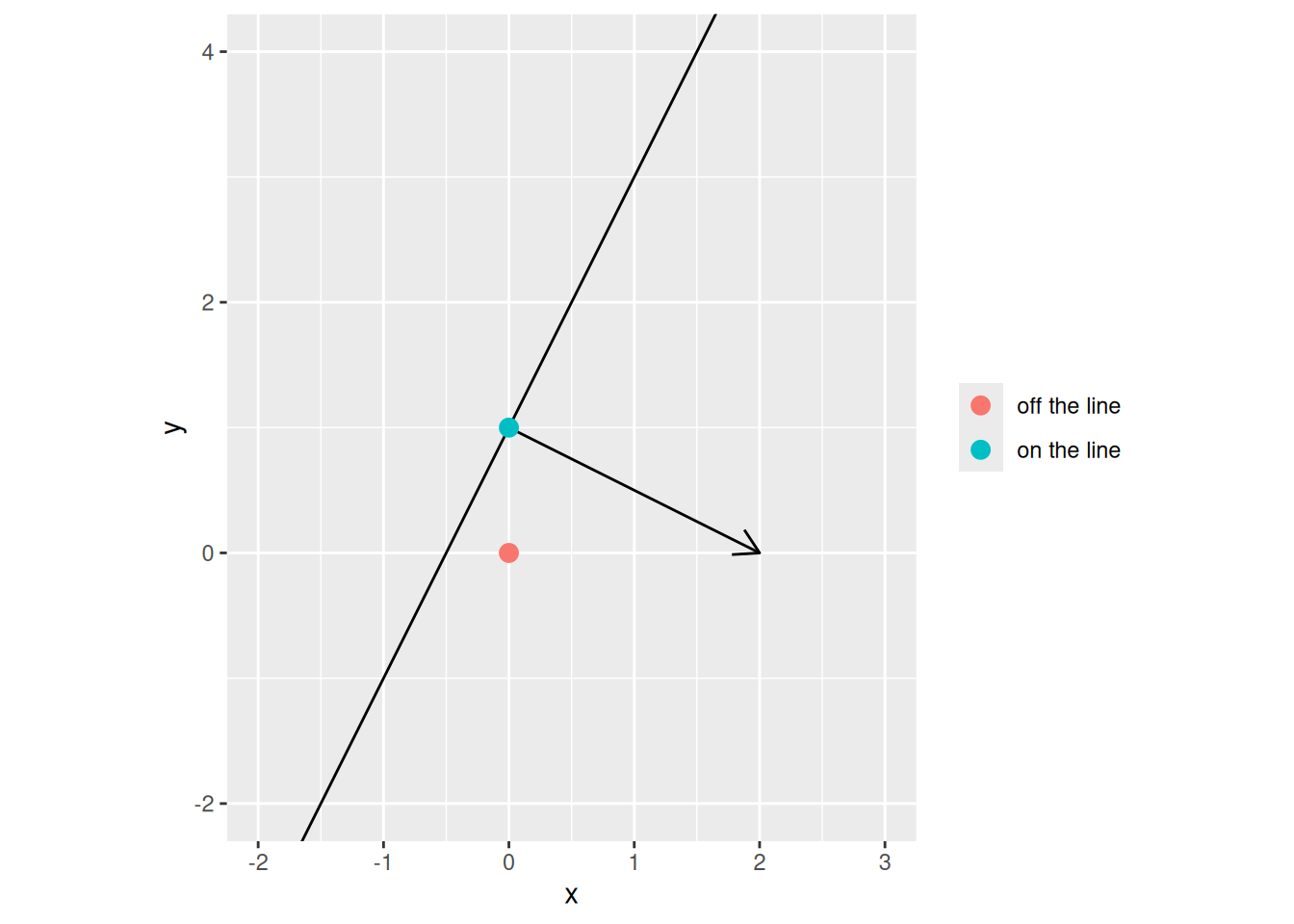
ExrExercise 4 (Finding the normal vector of the graph of a regression surface)
Exercise 4 (Finding the normal vector of the graph of a regression surface) Theorem 3 says that the graph of \(\mathord{\smash[b]{\underset{\raise.3ex\hbox{$\scriptstyle\sim$}}{x}}\vphantom{x}}\mapsto \mathord{\smash[b]{\underset{\raise.3ex\hbox{$\scriptstyle\sim$}}{w}}\vphantom{w}} \cdot \mathord{\smash[b]{\underset{\raise.3ex\hbox{$\scriptstyle\sim$}}{x}}\vphantom{x}} + b\) is a hyperplane in \(\mathbb{R}^{p+1}\). Let \(f(x_1, x_2) = 3 x_1 - x_2 + 2\), a regression surface with two features.
Find a normal vector for the graph of \(f\) in \(\mathbb{R}^3\).
TipHint
Read off \(\mathord{\smash[b]{\underset{\raise.3ex\hbox{$\scriptstyle\sim$}}{w}}\vphantom{w}}\) and use the normal vector \(\begin{bmatrix}\mathord{\smash[b]{\underset{\raise.3ex\hbox{$\scriptstyle\sim$}}{w}}\vphantom{w}}\\ -1\end{bmatrix}\) from Theorem 3.
DefDefinition 2 (Open half-space)
Definition 2 (Open half-space) Let \(\mathcal{H} = \mathopen{}\left\{\mathord{\smash[b]{\underset{\raise.3ex\hbox{$\scriptstyle\sim$}}{x}}\vphantom{x}}\in \mathbb{R}^p : \mathord{\smash[b]{\underset{\raise.3ex\hbox{$\scriptstyle\sim$}}{w}}\vphantom{w}} \cdot \mathord{\smash[b]{\underset{\raise.3ex\hbox{$\scriptstyle\sim$}}{x}}\vphantom{x}} + b = 0\right\}\mathclose{}\) be a hyperplane (Definition 10 in Linear and Affine Maps). The two open half-spaces [2] of \(\mathcal{H}\) are
\[ \mathcal{H}^+ \stackrel{\text{def}}{=}\mathopen{}\left\{\mathord{\smash[b]{\underset{\raise.3ex\hbox{$\scriptstyle\sim$}}{x}}\vphantom{x}}\in \mathbb{R}^p : \mathord{\smash[b]{\underset{\raise.3ex\hbox{$\scriptstyle\sim$}}{w}}\vphantom{w}} \cdot \mathord{\smash[b]{\underset{\raise.3ex\hbox{$\scriptstyle\sim$}}{x}}\vphantom{x}} + b > 0\right\}\mathclose{} \quad \text{and} \quad \mathcal{H}^- \stackrel{\text{def}}{=}\mathopen{}\left\{\mathord{\smash[b]{\underset{\raise.3ex\hbox{$\scriptstyle\sim$}}{x}}\vphantom{x}}\in \mathbb{R}^p : \mathord{\smash[b]{\underset{\raise.3ex\hbox{$\scriptstyle\sim$}}{w}}\vphantom{w}} \cdot \mathord{\smash[b]{\underset{\raise.3ex\hbox{$\scriptstyle\sim$}}{x}}\vphantom{x}} + b < 0\right\}\mathclose{}. \tag{1}\]
DefDefinition 3 (Closed half-space)
Definition 3 (Closed half-space) The closed half-spaces of the hyperplane \(\mathcal{H}\) of Definition 2 also include \(\mathcal{H}\) itself: \(\mathcal{H}^+ \cup \mathcal{H}\) and \(\mathcal{H}^- \cup \mathcal{H}\).
RemarkRemark
Remark. Replacing \((\mathord{\smash[b]{\underset{\raise.3ex\hbox{$\scriptstyle\sim$}}{w}}\vphantom{w}}, b)\) by \((-\mathord{\smash[b]{\underset{\raise.3ex\hbox{$\scriptstyle\sim$}}{w}}\vphantom{w}}, -b)\) describes the same hyperplane but swaps the names \(\mathcal{H}^+\) and \(\mathcal{H}^-\). The sign of \(\mathord{\smash[b]{\underset{\raise.3ex\hbox{$\scriptstyle\sim$}}{w}}\vphantom{w}} \cdot \mathord{\smash[b]{\underset{\raise.3ex\hbox{$\scriptstyle\sim$}}{x}}\vphantom{x}} + b\) tells you which side of the hyperplane \(\mathord{\smash[b]{\underset{\raise.3ex\hbox{$\scriptstyle\sim$}}{x}}\vphantom{x}}\) is on. A linear classifier uses this sign to assign one of two labels.
ExmExample 5 (Half-spaces of a line in the plane)
Example 5 (Half-spaces of a line in the plane) Let \(\mathcal{H}\) be the line in \(\mathbb{R}^2\) with \(\mathord{\smash[b]{\underset{\raise.3ex\hbox{$\scriptstyle\sim$}}{w}}\vphantom{w}} = (1, 2)\) and \(b = -2\) (Definition 10 in Linear and Affine Maps), so \(\mathcal{H} = \mathopen{}\left\{\mathord{\smash[b]{\underset{\raise.3ex\hbox{$\scriptstyle\sim$}}{x}}\vphantom{x}}: x_1 + 2 x_2 - 2 = 0\right\}\mathclose{}\). Evaluate \(\mathord{\smash[b]{\underset{\raise.3ex\hbox{$\scriptstyle\sim$}}{w}}\vphantom{w}} \cdot \mathord{\smash[b]{\underset{\raise.3ex\hbox{$\scriptstyle\sim$}}{x}}\vphantom{x}} + b\) at three points (Definition 2):
- At \((0, 0)\) it equals \(0 + 0 - 2 = -2 < 0\), so \((0, 0) \in \mathcal{H}^-\).
- At \((2, 0)\) it equals \(2 + 0 - 2 = 0\), so \((2, 0) \in \mathcal{H}\).
- At \((2, 1)\) it equals \(2 + 2 - 2 = 2 > 0\), so \((2, 1) \in \mathcal{H}^+\).
Moving from \((2, 0)\) in the direction \(\mathord{\smash[b]{\underset{\raise.3ex\hbox{$\scriptstyle\sim$}}{w}}\vphantom{w}} = (1, 2)\) gives \((3, 2)\), where the value is \(3 + 4 - 2 = 5 > 0\). So the direction \(\mathord{\smash[b]{\underset{\raise.3ex\hbox{$\scriptstyle\sim$}}{w}}\vphantom{w}}\) leads into \(\mathcal{H}^+\).
ExrExercise 5 (Finding which open half-space holds a point)
Exercise 5 (Finding which open half-space holds a point) The sign of \(\mathord{\smash[b]{\underset{\raise.3ex\hbox{$\scriptstyle\sim$}}{w}}\vphantom{w}} \cdot \mathord{\smash[b]{\underset{\raise.3ex\hbox{$\scriptstyle\sim$}}{x}}\vphantom{x}} + b\) tells which open half-space of a hyperplane a point \(\mathord{\smash[b]{\underset{\raise.3ex\hbox{$\scriptstyle\sim$}}{x}}\vphantom{x}}\) lies in. Let \(\mathcal{H}\) be the line in \(\mathbb{R}^2\) with \(\mathord{\smash[b]{\underset{\raise.3ex\hbox{$\scriptstyle\sim$}}{w}}\vphantom{w}} = (2, -1)\) and \(b = -1\).
Decide whether \((0, 0)\) is in \(\mathcal{H}^+\) or in \(\mathcal{H}^-\).
TipHint
Evaluate \(\mathord{\smash[b]{\underset{\raise.3ex\hbox{$\scriptstyle\sim$}}{w}}\vphantom{w}} \cdot \mathord{\smash[b]{\underset{\raise.3ex\hbox{$\scriptstyle\sim$}}{x}}\vphantom{x}} + b\) at \((0, 0)\).
ExrExercise 6 (Testing whether a point is in a closed half-space)
Exercise 6 (Testing whether a point is in a closed half-space) A closed half-space adds the hyperplane itself to an open half-space. Let \(\mathcal{H}\) be the line in \(\mathbb{R}^2\) with \(\mathord{\smash[b]{\underset{\raise.3ex\hbox{$\scriptstyle\sim$}}{w}}\vphantom{w}} = (2, -1)\) and \(b = -3\).
Decide whether the point \((2, 1)\) is in the closed half-space \(\mathcal{H}^+ \cup \mathcal{H}\).
TipHint
Evaluate \(\mathord{\smash[b]{\underset{\raise.3ex\hbox{$\scriptstyle\sim$}}{w}}\vphantom{w}} \cdot \mathord{\smash[b]{\underset{\raise.3ex\hbox{$\scriptstyle\sim$}}{x}}\vphantom{x}} + b\) at \((2, 1)\).
RemarkRemark 1 (The two sides of a hyperplane)
Remark 1 (The two sides of a hyperplane). Every point of \(\mathbb{R}^p\) is in exactly one of \(\mathcal{H}^+\), \(\mathcal{H}\) and \(\mathcal{H}^-\), because the number \(\mathord{\smash[b]{\underset{\raise.3ex\hbox{$\scriptstyle\sim$}}{w}}\vphantom{w}} \cdot \mathord{\smash[b]{\underset{\raise.3ex\hbox{$\scriptstyle\sim$}}{x}}\vphantom{x}} + b\) is positive, zero or negative. The vector \(\mathord{\smash[b]{\underset{\raise.3ex\hbox{$\scriptstyle\sim$}}{w}}\vphantom{w}}\) points into \(\mathcal{H}^+\): the number \(\mathord{\smash[b]{\underset{\raise.3ex\hbox{$\scriptstyle\sim$}}{w}}\vphantom{w}} \cdot \mathord{\smash[b]{\underset{\raise.3ex\hbox{$\scriptstyle\sim$}}{x}}\vphantom{x}} + b\) goes up when \(\mathord{\smash[b]{\underset{\raise.3ex\hbox{$\scriptstyle\sim$}}{x}}\vphantom{x}}\) moves in the direction \(\mathord{\smash[b]{\underset{\raise.3ex\hbox{$\scriptstyle\sim$}}{w}}\vphantom{w}}\).
LemTheorem 4 (Differences of points in a hyperplane and in a half-space)
Theorem 4 (Differences of points in a hyperplane and in a half-space) Let \(\mathord{\smash[b]{\underset{\raise.3ex\hbox{$\scriptstyle\sim$}}{w}}\vphantom{w}} \in \mathbb{R}^p\) be nonzero, let \(b \in \mathbb{R}\), and let \(\mathcal{H}\), \(\mathcal{H}^+\) be the hyperplane and open half-space of Definition 2. For a set \(S \subseteq \mathbb{R}^p\), let \(D(S) \stackrel{\text{def}}{=}\mathopen{}\left\{\mathord{\smash[b]{\underset{\raise.3ex\hbox{$\scriptstyle\sim$}}{y}}\vphantom{y}}- \mathord{\smash[b]{\underset{\raise.3ex\hbox{$\scriptstyle\sim$}}{x}}\vphantom{x}}: \mathord{\smash[b]{\underset{\raise.3ex\hbox{$\scriptstyle\sim$}}{x}}\vphantom{x}}, \mathord{\smash[b]{\underset{\raise.3ex\hbox{$\scriptstyle\sim$}}{y}}\vphantom{y}}\in S\right\}\mathclose{}\) be the set of differences of its points.
- \(D(\mathcal{H}) = \mathopen{}\left\{\mathord{\smash[b]{\underset{\raise.3ex\hbox{$\scriptstyle\sim$}}{s}}\vphantom{s}} : \mathord{\smash[b]{\underset{\raise.3ex\hbox{$\scriptstyle\sim$}}{w}}\vphantom{w}} \cdot \mathord{\smash[b]{\underset{\raise.3ex\hbox{$\scriptstyle\sim$}}{s}}\vphantom{s}} = 0\right\}\mathclose{}\), a subspace of dimension \(p - 1\).
- \(D(\mathcal{H}^+) = \mathbb{R}^p\), a subspace of dimension \(p\).
The same holds for \(\mathcal{H}^-\).
ProofProof
Proof. Part 1. Let \(\mathord{\smash[b]{\underset{\raise.3ex\hbox{$\scriptstyle\sim$}}{x}}\vphantom{x}}, \mathord{\smash[b]{\underset{\raise.3ex\hbox{$\scriptstyle\sim$}}{y}}\vphantom{y}}\in \mathcal{H}\). By Theorem 1 part 3, \(\mathord{\smash[b]{\underset{\raise.3ex\hbox{$\scriptstyle\sim$}}{w}}\vphantom{w}} \cdot (\mathord{\smash[b]{\underset{\raise.3ex\hbox{$\scriptstyle\sim$}}{y}}\vphantom{y}}- \mathord{\smash[b]{\underset{\raise.3ex\hbox{$\scriptstyle\sim$}}{x}}\vphantom{x}}) = 0\), so \(\mathord{\smash[b]{\underset{\raise.3ex\hbox{$\scriptstyle\sim$}}{y}}\vphantom{y}}- \mathord{\smash[b]{\underset{\raise.3ex\hbox{$\scriptstyle\sim$}}{x}}\vphantom{x}}\in \mathcal{H}_0 = \mathopen{}\left\{\mathord{\smash[b]{\underset{\raise.3ex\hbox{$\scriptstyle\sim$}}{s}}\vphantom{s}} : \mathord{\smash[b]{\underset{\raise.3ex\hbox{$\scriptstyle\sim$}}{w}}\vphantom{w}} \cdot \mathord{\smash[b]{\underset{\raise.3ex\hbox{$\scriptstyle\sim$}}{s}}\vphantom{s}} = 0\right\}\mathclose{}\). Conversely, take any \(\mathord{\smash[b]{\underset{\raise.3ex\hbox{$\scriptstyle\sim$}}{x}}\vphantom{x}}_0 \in \mathcal{H}\) (Theorem 1 part 2 gives such a point). For any \(\mathord{\smash[b]{\underset{\raise.3ex\hbox{$\scriptstyle\sim$}}{s}}\vphantom{s}} \in \mathcal{H}_0\), the point \(\mathord{\smash[b]{\underset{\raise.3ex\hbox{$\scriptstyle\sim$}}{x}}\vphantom{x}}_0 + \mathord{\smash[b]{\underset{\raise.3ex\hbox{$\scriptstyle\sim$}}{s}}\vphantom{s}}\) is in \(\mathcal{H}\) by the same part, and \((\mathord{\smash[b]{\underset{\raise.3ex\hbox{$\scriptstyle\sim$}}{x}}\vphantom{x}}_0 + \mathord{\smash[b]{\underset{\raise.3ex\hbox{$\scriptstyle\sim$}}{s}}\vphantom{s}}) - \mathord{\smash[b]{\underset{\raise.3ex\hbox{$\scriptstyle\sim$}}{x}}\vphantom{x}}_0 = \mathord{\smash[b]{\underset{\raise.3ex\hbox{$\scriptstyle\sim$}}{s}}\vphantom{s}}\). So \(D(\mathcal{H}) = \mathcal{H}_0\), which has dimension \(p - 1\) by Theorem 1 part 1.
Part 2. Every difference is in \(\mathbb{R}^p\), so \(D(\mathcal{H}^+) \subseteq \mathbb{R}^p\). For the reverse inclusion, take any \(\mathord{\smash[b]{\underset{\raise.3ex\hbox{$\scriptstyle\sim$}}{x}}\vphantom{x}}_0 \in \mathcal{H}\). Take any \(\mathord{\smash[b]{\underset{\raise.3ex\hbox{$\scriptstyle\sim$}}{v}}\vphantom{v}} \in \mathbb{R}^p\). For a number \(t > 0\) to be chosen, let \(\mathord{\smash[b]{\underset{\raise.3ex\hbox{$\scriptstyle\sim$}}{x}}\vphantom{x}}_t \stackrel{\text{def}}{=}\mathord{\smash[b]{\underset{\raise.3ex\hbox{$\scriptstyle\sim$}}{x}}\vphantom{x}}_0 + t\,\mathord{\smash[b]{\underset{\raise.3ex\hbox{$\scriptstyle\sim$}}{w}}\vphantom{w}}\). Then
\[ \begin{aligned} \mathord{\smash[b]{\underset{\raise.3ex\hbox{$\scriptstyle\sim$}}{w}}\vphantom{w}} \cdot \mathord{\smash[b]{\underset{\raise.3ex\hbox{$\scriptstyle\sim$}}{x}}\vphantom{x}}_t + b &= \mathopen{}\left(\mathord{\smash[b]{\underset{\raise.3ex\hbox{$\scriptstyle\sim$}}{w}}\vphantom{w}} \cdot \mathord{\smash[b]{\underset{\raise.3ex\hbox{$\scriptstyle\sim$}}{x}}\vphantom{x}}_0 + b\right)\mathclose{} + t\,\mathord{\smash[b]{\underset{\raise.3ex\hbox{$\scriptstyle\sim$}}{w}}\vphantom{w}} \cdot \mathord{\smash[b]{\underset{\raise.3ex\hbox{$\scriptstyle\sim$}}{w}}\vphantom{w}} && \text{(linearity of } \mathord{\smash[b]{\underset{\raise.3ex\hbox{$\scriptstyle\sim$}}{x}}\vphantom{x}}\mapsto \mathord{\smash[b]{\underset{\raise.3ex\hbox{$\scriptstyle\sim$}}{w}}\vphantom{w}} \cdot \mathord{\smash[b]{\underset{\raise.3ex\hbox{$\scriptstyle\sim$}}{x}}\vphantom{x}} \text{)} \\ &= t\,\mathord{\smash[b]{\underset{\raise.3ex\hbox{$\scriptstyle\sim$}}{w}}\vphantom{w}} \cdot \mathord{\smash[b]{\underset{\raise.3ex\hbox{$\scriptstyle\sim$}}{w}}\vphantom{w}}, && \text{(} \mathord{\smash[b]{\underset{\raise.3ex\hbox{$\scriptstyle\sim$}}{x}}\vphantom{x}}_0 \in \mathcal{H} \text{)} \end{aligned} \]
which is positive, so \(\mathord{\smash[b]{\underset{\raise.3ex\hbox{$\scriptstyle\sim$}}{x}}\vphantom{x}}_t \in \mathcal{H}^+\). Next,
\[ \begin{aligned} \mathord{\smash[b]{\underset{\raise.3ex\hbox{$\scriptstyle\sim$}}{w}}\vphantom{w}} \cdot (\mathord{\smash[b]{\underset{\raise.3ex\hbox{$\scriptstyle\sim$}}{x}}\vphantom{x}}_t + \mathord{\smash[b]{\underset{\raise.3ex\hbox{$\scriptstyle\sim$}}{v}}\vphantom{v}}) + b &= \mathopen{}\left(\mathord{\smash[b]{\underset{\raise.3ex\hbox{$\scriptstyle\sim$}}{w}}\vphantom{w}} \cdot \mathord{\smash[b]{\underset{\raise.3ex\hbox{$\scriptstyle\sim$}}{x}}\vphantom{x}}_t + b\right)\mathclose{} + \mathord{\smash[b]{\underset{\raise.3ex\hbox{$\scriptstyle\sim$}}{w}}\vphantom{w}} \cdot \mathord{\smash[b]{\underset{\raise.3ex\hbox{$\scriptstyle\sim$}}{v}}\vphantom{v}} && \text{(linearity of } \mathord{\smash[b]{\underset{\raise.3ex\hbox{$\scriptstyle\sim$}}{x}}\vphantom{x}}\mapsto \mathord{\smash[b]{\underset{\raise.3ex\hbox{$\scriptstyle\sim$}}{w}}\vphantom{w}} \cdot \mathord{\smash[b]{\underset{\raise.3ex\hbox{$\scriptstyle\sim$}}{x}}\vphantom{x}} \text{)} \\ &= t\,\mathord{\smash[b]{\underset{\raise.3ex\hbox{$\scriptstyle\sim$}}{w}}\vphantom{w}} \cdot \mathord{\smash[b]{\underset{\raise.3ex\hbox{$\scriptstyle\sim$}}{w}}\vphantom{w}} + \mathord{\smash[b]{\underset{\raise.3ex\hbox{$\scriptstyle\sim$}}{w}}\vphantom{w}} \cdot \mathord{\smash[b]{\underset{\raise.3ex\hbox{$\scriptstyle\sim$}}{v}}\vphantom{v}}. && \text{(the display above)} \end{aligned} \]
Because \(\mathord{\smash[b]{\underset{\raise.3ex\hbox{$\scriptstyle\sim$}}{w}}\vphantom{w}} \cdot \mathord{\smash[b]{\underset{\raise.3ex\hbox{$\scriptstyle\sim$}}{w}}\vphantom{w}} > 0\), this is positive once \(t > -\mathord{\smash[b]{\underset{\raise.3ex\hbox{$\scriptstyle\sim$}}{w}}\vphantom{w}} \cdot \mathord{\smash[b]{\underset{\raise.3ex\hbox{$\scriptstyle\sim$}}{v}}\vphantom{v}} / \mathord{\smash[b]{\underset{\raise.3ex\hbox{$\scriptstyle\sim$}}{w}}\vphantom{w}} \cdot \mathord{\smash[b]{\underset{\raise.3ex\hbox{$\scriptstyle\sim$}}{w}}\vphantom{w}}\). Choose such a \(t > 0\). Then \(\mathord{\smash[b]{\underset{\raise.3ex\hbox{$\scriptstyle\sim$}}{x}}\vphantom{x}}_t\) and \(\mathord{\smash[b]{\underset{\raise.3ex\hbox{$\scriptstyle\sim$}}{x}}\vphantom{x}}_t + \mathord{\smash[b]{\underset{\raise.3ex\hbox{$\scriptstyle\sim$}}{v}}\vphantom{v}}\) are both in \(\mathcal{H}^+\), and their difference is \(\mathord{\smash[b]{\underset{\raise.3ex\hbox{$\scriptstyle\sim$}}{v}}\vphantom{v}}\). So \(\mathord{\smash[b]{\underset{\raise.3ex\hbox{$\scriptstyle\sim$}}{v}}\vphantom{v}} \in D(\mathcal{H}^+)\). The whole space \(\mathbb{R}^p\) is a subspace of dimension \(p\) (Definition 9 in Subspaces and Rank).
The proof for \(\mathcal{H}^-\) is the same with \(-\mathord{\smash[b]{\underset{\raise.3ex\hbox{$\scriptstyle\sim$}}{w}}\vphantom{w}}\) and \(-b\) in place of \(\mathord{\smash[b]{\underset{\raise.3ex\hbox{$\scriptstyle\sim$}}{w}}\vphantom{w}}\) and \(b\).
ExmExample 6 (Two iris species on either side of a line)
Example 6 (Two iris species on either side of a line) The iris data set in R has the petal length and petal width, in centimeters, of 150 irises. Take the 100 flowers of the species versicolor and virginica, and let \(\mathord{\smash[b]{\underset{\raise.3ex\hbox{$\scriptstyle\sim$}}{x}}\vphantom{x}}= (x_1, x_2)\) be the petal length and petal width of one flower. A logistic regression of the species on \(\mathord{\smash[b]{\underset{\raise.3ex\hbox{$\scriptstyle\sim$}}{x}}\vphantom{x}}\) gives a coefficient vector \(\mathord{\smash[b]{\underset{\raise.3ex\hbox{$\scriptstyle\sim$}}{w}}\vphantom{w}}\) and an intercept \(b\). The line \(\mathord{\smash[b]{\underset{\raise.3ex\hbox{$\scriptstyle\sim$}}{w}}\vphantom{w}} \cdot \mathord{\smash[b]{\underset{\raise.3ex\hbox{$\scriptstyle\sim$}}{x}}\vphantom{x}} + b = 0\) is a hyperplane in \(\mathbb{R}^2\) (Definition 10 in Linear and Affine Maps), and the two species mostly fall in its two open half-spaces (Definition 2). Figure 2 shows the line and the flowers.
Show code
two_species <- dplyr::filter(iris, Species != "setosa") |> droplevels()
fit <- glm(
  Species ~ Petal.Length + Petal.Width,
  family = binomial,
  data = two_species
)
w <- coef(fit)[c("Petal.Length", "Petal.Width")]
b <- coef(fit)[["(Intercept)"]]
two_species$score <- as.vector(
  as.matrix(two_species[c("Petal.Length", "Petal.Width")]) %*% w + b
)
two_species$side <- ifelse(two_species$score > 0, "positive", "negative")
ggplot2::ggplot(two_species) +
  ggplot2::aes(x = Petal.Length, y = Petal.Width, colour = Species) +
  ggplot2::geom_point() +
  ggplot2::geom_abline(intercept = -b / w[[2]], slope = -w[[1]] / w[[2]]) +
  ggplot2::labs(x = "Petal length (cm)", y = "Petal width (cm)")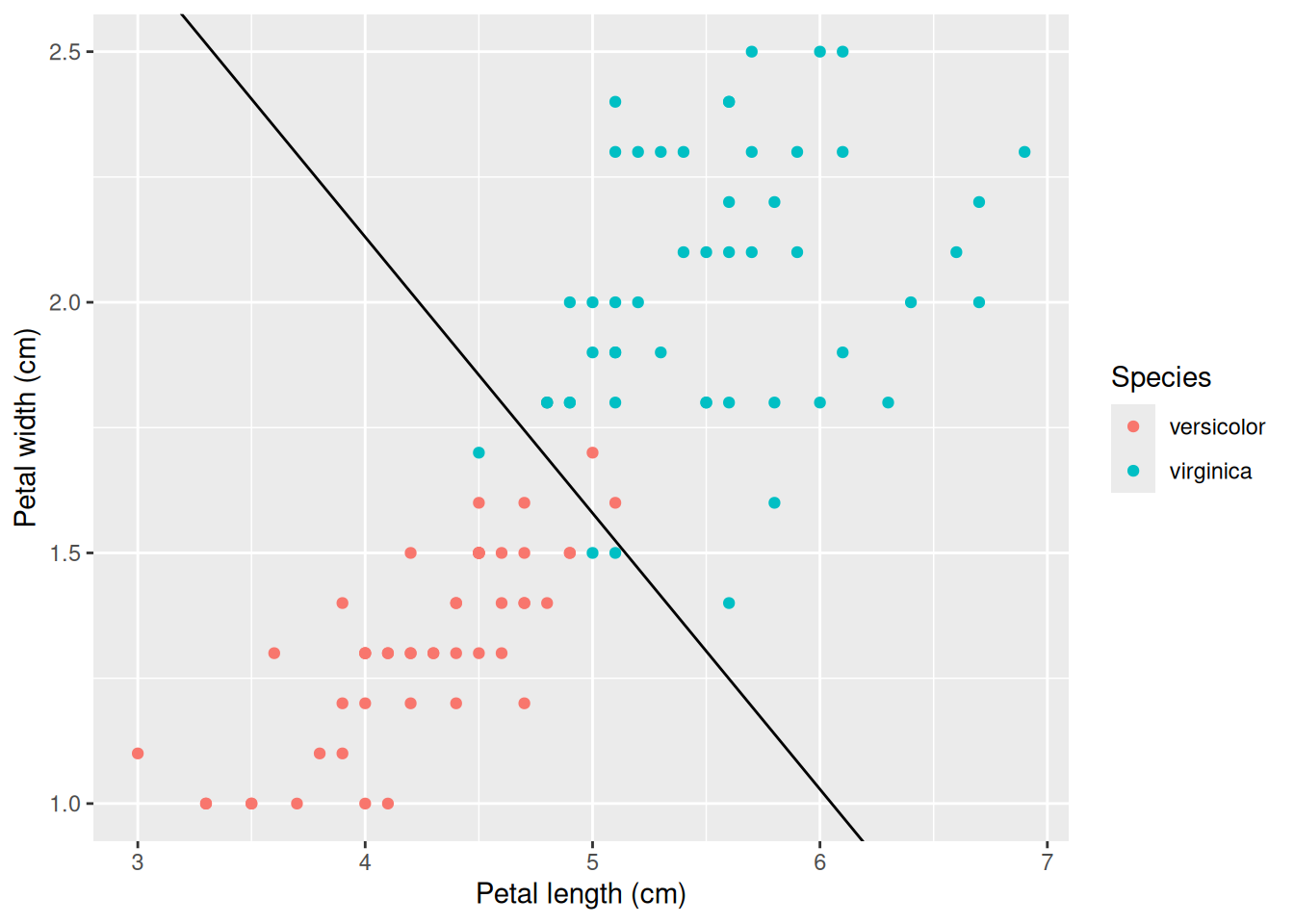
table(two_species$Species, two_species$side)
#>
#>              negative positive
#>   versicolor       47        3
#>   virginica         3       47
The vector \(\mathord{\smash[b]{\underset{\raise.3ex\hbox{$\scriptstyle\sim$}}{w}}\vphantom{w}}\) points toward the virginica side, so the positive half-space \(\mathcal{H}^+\) holds 50 of the 100 flowers, and 47 of them are virginica. The line is a set of dimension \(p - 1 = 1\), and each side is a region of the plane of dimension \(p = 2\) (Theorem 4).
ExrExercise 7 (Which side of the plane?)
Exercise 7 (Which side of the plane?) Let \(\mathcal{H}\) be the plane in \(\mathbb{R}^3\) with \(\mathord{\smash[b]{\underset{\raise.3ex\hbox{$\scriptstyle\sim$}}{w}}\vphantom{w}} = (1, 1, 1)\) and \(b = -1\) (Example 2).
- For each point, say whether it is in \(\mathcal{H}^+\), \(\mathcal{H}\) or \(\mathcal{H}^-\) (Definition 2): \((0, 0, 0)\), \((1, 0, 0)\) and \((1, 1, 1)\).
- Write the plane and its half-spaces using \(-\mathord{\smash[b]{\underset{\raise.3ex\hbox{$\scriptstyle\sim$}}{w}}\vphantom{w}}\) and \(-b\). Which points from part 1 change sides?
- State the dimension of \(D(\mathcal{H})\) and of \(D(\mathcal{H}^+)\) (Theorem 4).
Definitions on this page
References
[1]
Wikipedia contributors, “Affine space — Wikipedia, the free encyclopedia.” 2026. Available: https://en.wikipedia.org/wiki/Affine_space
[2]
Wikipedia contributors, “Half-space (geometry) — Wikipedia, the free encyclopedia.” 2026. Available: https://en.wikipedia.org/wiki/Half-space_(geometry)